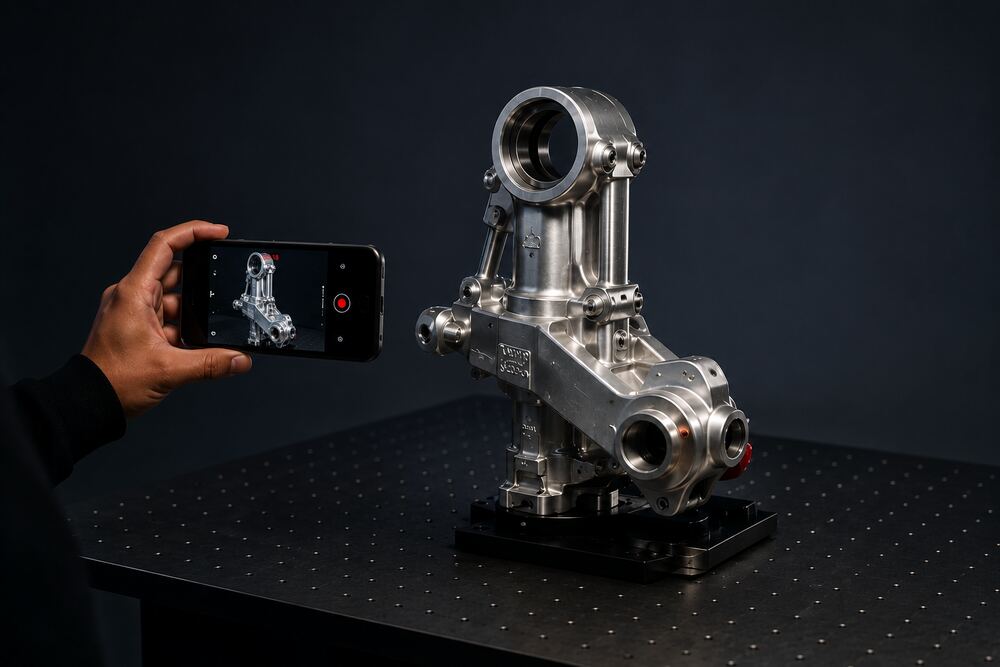
When a part leaves a factory in perfect condition and arrives damaged, the question everyone asks is the same: whose fault is it? Answering that used to mean digging through paper checklists and a handful of phone photos. Today, it can mean pulling up a fully navigable 3D reconstruction of the part exactly as it looked the moment it shipped.
That's the promise of Gaussian Splatting applied to industrial quality assurance — and it's why we built an end-to-end digital twin platform for one of our aerospace clients' final inspection workflow.
What is Gaussian Splatting?
Gaussian Splatting is a 3D reconstruction technique that represents a scene as millions of small, colored "splats" rather than a traditional polygon mesh. Trained from a set of ordinary video frames or photos, it produces photorealistic, freely navigable 3D scenes far faster than classical photogrammetry pipelines — without sacrificing visual fidelity.
For inspection use cases, that combination of speed and fidelity is the whole point: you don't need a CAD-perfect mesh, you need an honest, high-resolution record of what a physical object actually looked like at a specific point in time.
From video to legal documentation
We designed the workflow to fit inside an existing QA checkpoint rather than replace it. A QA inspector films a short walk-around video of the part with a phone or handheld camera — no special rig required. That video is uploaded to the platform, which automatically:
- Reconstructs the part as a Gaussian Splat digital twin
- Timestamps and stores the reconstruction as an auditable record
- Generates supporting documentation that can be referenced if a damage dispute comes up later
No manual 3D modeling, no specialized capture hardware, and no workflow retraining beyond "film a walk-around video before it ships."
The goal isn't a prettier 3D model — it's an audit trail that holds up when a client says "it arrived damaged" and you need to know whether that's true.
Case study: Landing gear final inspection at Safran
We deployed this exact pipeline with Safran for landing gear final inspection. Before shipment, a QA inspector captures a video of the unit; the platform turns it into a digital twin plus legal documentation certifying its pre-shipment condition.
Early results from the deployment:
- ~2–3 hour turnaround, video to finished digital twin, no manual 3D modeling required
- ~40% fewer disputed damage claims, backed by timestamped proof of pre-shipment condition
- 480+ units inspected since deployment, each with an auditable digital record
For a business where a single disputed claim can mean weeks of back-and-forth and a damaged relationship with a client, having an objective, timestamped 3D record changes the conversation entirely.
Where this fits beyond aerospace
Any handoff point where "condition at time X" matters — pre-shipment, pre-rental, insurance claims, warranty disputes — is a candidate for this workflow. The hardware requirements are minimal; the value comes from making 3D documentation as easy as filming a video.