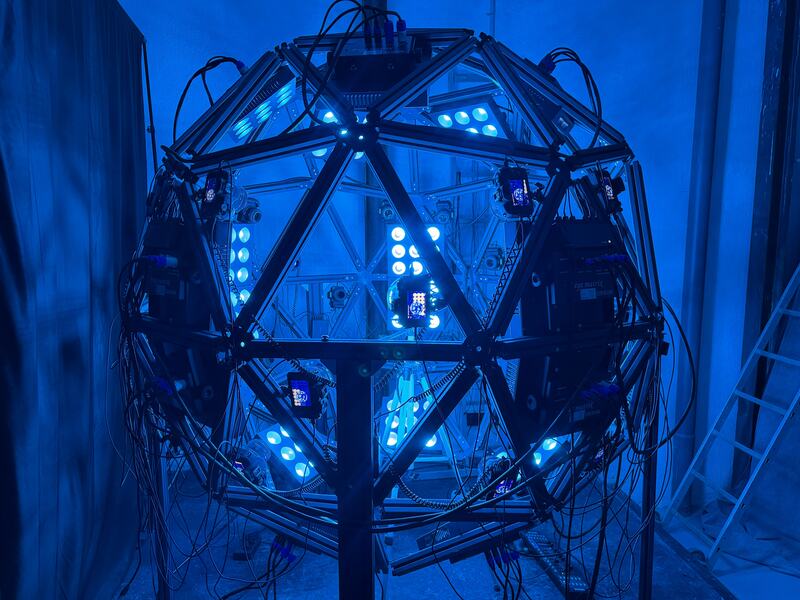
Every scan we deliver — a human dataset, a fashion product, an actor's digital double — starts in the same place: the Light Cage. It's the physical heart of Metascan's capture pipeline, and it's the reason we can go from "someone sits down" to a production-ready 3D asset in a matter of seconds. Here's what's actually happening inside it.
What the Light Cage is
The Light Cage is a custom-built capture rig: a dome or enclosure lined with synchronized cameras and programmable lighting, purpose-built to photograph a subject from every angle at once. Depending on the job, that means anywhere from a handful of cameras for a small hand scanner up to hundreds of cameras for a room-scale, full-body rig. The subject — a person, a product, a prop — sits or stands in the center, and the whole system fires in a fraction of a second, freezing every angle simultaneously so there's no movement to reconcile between shots.
Spherical polarized lighting, not just more cameras
More cameras alone don't guarantee a good scan — bad lighting will still cost you detail. The Light Cage uses spherical polarized lighting arranged around the subject, which lets us separate the specular reflection (the shine off skin, fabric, or a glossy surface) from the diffuse color underneath it. That separation is what makes it possible to extract specular, diffuse, and normal maps directly from the capture, instead of trying to paint them in later.
Cameras and lights are precisely synchronized through custom hardware and configurable software, so every exposure across every camera happens in lockstep. That's what turns "a room full of cameras" into a coherent, calibrated capture system rather than a pile of unrelated photos.
What comes out the other side
The output isn't just a point cloud or a rough mesh — it's a full set of production-ready maps: detailed geometry, specular and diffuse texture, and normal maps, with minimal post-processing required. For teams building AI training datasets, that means consistent, high-fidelity captures at scale. For VFX and production pipelines, it means an asset that can go straight into rigging and compositing without a manual retopology pass.
One rig, many jobs
Because the underlying system — synchronized cameras, controlled polarized lighting — is the same regardless of subject, the Light Cage scales across very different use cases:
- Human dataset creation — heads, hands, and full bodies for realistic AI avatars
- Fashion tech and e-commerce — garments and products for 3D viewers and virtual try-on
- VFX and digital doubles — actors and props captured with production-grade texture fidelity
- Cultural heritage — objects and artifacts documented at high resolution with minimal handling
The rig itself doesn't change between these — what changes is scale, subject, and how the resulting maps get used downstream.
Why it matters
A lot of 3D capture pipelines trade one thing for another: fast but low-fidelity, or high-fidelity but slow and hands-on in post. The Light Cage is built to avoid that trade-off — synchronized capture removes motion artifacts, polarized lighting removes the guesswork from separating texture and reflection, and the result is an asset that's usable almost immediately. That's the difference between a scan being a starting point for weeks of cleanup, and a scan being the deliverable.